The Metadata Subsystem
Crab maintains two SlateDB databases that map content to storage locations. These databases are what make deduplication and hydration fast — without them, every operation would need to scan all shards.
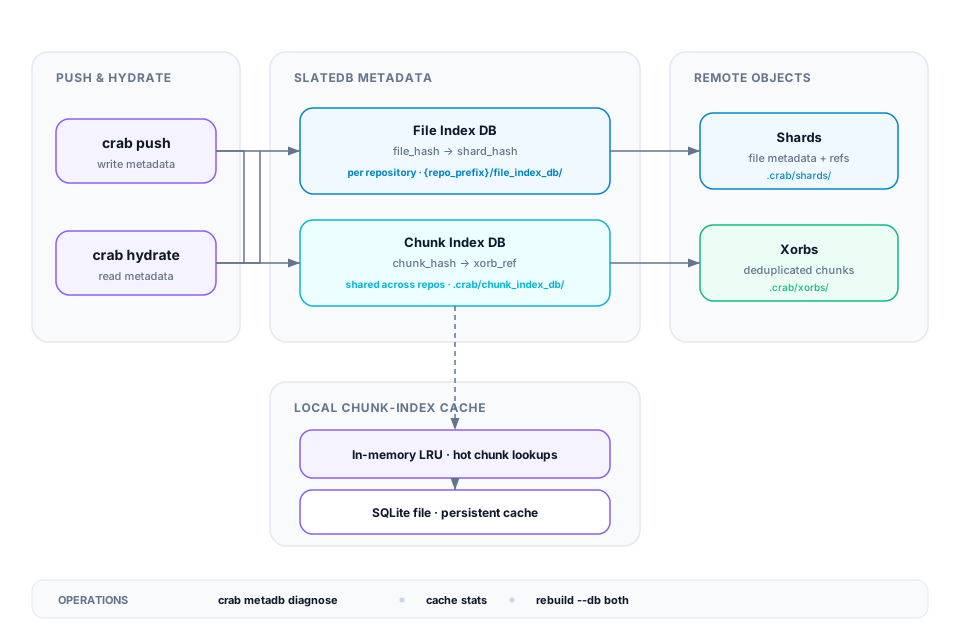
Two Databases
| Database | Location | Maps | Purpose |
|---|---|---|---|
| File Index | {repo_prefix}/file_index_db/ | file_hash → shard_hash | Find which shard contains a file's metadata |
| Chunk Index | .crab/chunk_index_db/ | chunk_hash → xorb_ref | Find which xorb contains a specific chunk (dedup) |
The file index is per-repository. The chunk index is shared globally across all repositories in a bucket, enabling cross-repo deduplication.
Local Cache
A two-tier local cache sits in front of the remote chunk index:
- In-memory LRU — fastest lookups for hot chunks
- SQLite file — persistent bucket-scoped cache at
~/.cache/crab/buckets/{bucket-hash}/chunk-index.sqlite
Diagnosing Issues
Check database health
crab metadb diagnose --deepRead-only health snapshot — reports open state, format version, epoch, and path for each database. Add --deep to scan every metadata row and enumerate the backing object store. Deep diagnosis validates committed/receipt namespaces and flags malformed compacted-SST names as warnings; it never deletes remote objects. Safe to run concurrently with pushes.
crab metadb diagnose --db chunk_index
crab metadb diagnose --db file_index --json
Check local cache state
crab metadb cache statsShows the SQLite path, combined database/WAL/shared-memory size, entry count, installed shard count, and GC generation cursor. The read-only inspection does not create, migrate, repair, or load the cache into memory.
Run a durable Git index owner
For concurrent team pushes, keep one repository-scoped owner under a process supervisor:
crab metadb owner --interval 30 --jsonlIt reuses one exclusive locator writer across generations and publishes immutable read checkpoints before visibility repair. Push clients only pay an owner-lease probe and do not each rebuild the shared locator. If the owner is between generations or unavailable, complete-pack fetch remains available and a client can resume the canonical repair path after the lease expires.
Rebuilding from Shards
When a database is corrupted (unreadable manifest, damaged WAL, or accidental deletion), rebuild it from the source shards:
crab metadb rebuild --db chunk_index
crab metadb rebuild --db file_index
crab metadb rebuild --db both
Rebuild is idempotent — every write is content-addressed, so running it multiple times produces the same result. An interrupted run can be restarted without cleanup. Any manifest-named shard, xorb-placement, or Git-pack validation failure exits non-zero and prevents generation-receipt publication.
Compacting the Databases
crab metadb compact --db bothThis acquires a renewable repository maintenance lease and runs SlateDB's size-tiered compactor until the current scheduler work drains. File and chunk indexes run sequentially. Cancellation, an existing active compaction, or a new compaction failure exits non-zero; a database with no eligible work is reported as already policy-satisfied.
When to rebuild
crab metadb diagnosereports a manifest or WAL read failurecrab pushaborts withMetaDbError::Opendue to corruption- A database prefix was accidentally deleted from the bucket
When NOT to rebuild
Rebuild is not a migration tool. Fresh repositories never need it — Db::open creates databases automatically on the first push.
Clearing the Local Cache
crab metadb cache clearTransactionally removes cached chunk and shard rows, forcing a cold re-warm on the next operation. The remote state is untouched, and the local SQLite file, schema, and GC cursor remain intact for live shared handles.
Troubleshooting
| Symptom | Likely cause | Action |
|---|---|---|
Push fails with MetaDbError::Open | SlateDB manifest unreadable or wrong credentials | Run crab doctor --metadb, check credentials, rebuild if corrupt |
Hydrate reports FileNotFoundInFileIndexDb | File never pushed, or file_index_db missing entries | Verify file was pushed (check shards), rebuild file_index if needed |
| Push is slow, no dedup happening | Local cache empty or wiped | Run crab pull to warm cache, verify with crab metadb cache stats |
| Cache wiped unexpectedly | GC bumped remote generation beyond grace window | Expected after crab gc — cache refills on next pull/push |
Configuration
# .crab/local.toml
[metadb.file_index]
compaction_threshold = 4
wal_flush_size = 4194304          # 4 MiB
bloom_bits_per_key = 10

[metadb.chunk_index]
compaction_threshold = 4
wal_flush_size = 67108864         # 64 MiB
bloom_bits_per_key = 10
in_memory_ceiling_bytes = 1073741824  # 1 GiB
cache_gc_grace = 3
All settings can be overridden with CRAB_METADB_* environment variables (e.g., CRAB_METADB_CHUNK_INDEX_IN_MEMORY_CEILING_BYTES).
The shipped wal_flush_size key controls SlateDB's L0 SST target size; Crab
flushes WAL durability explicitly at commit boundaries. File-index and
chunk-index values are applied independently, and all three database tunables
must be non-zero.
Command Help
For complete command syntax and flags, run crab metadb --help or
crab metadb <subcommand> --help.